
Pasquotank County Court Docket Searches
Start with the North Carolina eCourts Portal. Pick Smart Search, type a party name or a full record number, and set Pasquotank County as the location. Advanced Filtering cannot run on its own. It needs a name or record number first. Once you have results, the filters narrow them by Pasquotank case type, status, filing-date range, and party criteria. The Portal is one statewide system, not a county-built database. Still, its Case Summary is the public record route for Pasquotank cases.
Treat a Portal result as a wayfinding tool. Grab the case number, caption, hearing entry, or document title. That gives the Pasquotank County Clerk of Superior Court a precise starting point when no public image exists. Access is free, and public data needs no registration. It is not a clerk-certified record, though. Some Pasquotank cases also call for an onsite terminal or a paper-file check, especially when information is restricted from remote display or predates the electronic conversion.
- Open Portal Smart Search and enter a party name or full case number.
- Set the location to Pasquotank and select a case category when the result is too broad.
- Open the Pasquotank Case Summary and note the complete number, Case Events, Hearings, and Disposition fields that appear.
- Use Search Hearings or the Pasquotank calendar to check a current setting.
- Ask the Pasquotank Clerk for inspection, a paper file, or a certified copy when Portal cannot supply the needed record.
Note: A Portal result identifies public case information, but it does not replace the clerk's official certification of a court file.
Pasquotank County Portal Docket Route
Smart Search accepts more than a name. Portal documentation lists search paths for a case or record number, citation number, attorney or bar number, business name, cross-reference number, and even a nickname, each through the right type of search. Pasquotank civil cases come with category filters for Civil Actions, nonconfidential Special Proceedings, and Estates. Criminal Actions and Bond Forfeitures are listed too. One gap stands out. You cannot search by charge or offense words, so a person who knows only an alleged offense should first get a case number or ask the Pasquotank clerk which public search channel applies.
The state's Portal training resources explain why visible Pasquotank sections differ from case to case. A case with no financial information, for instance, simply never gains a Financial Information section. The panel is not blank; it is absent. That conditional design makes a precise case number valuable. It also means a missing panel proves nothing about whether the case ever existed.
| Portal field | How it helps a Pasquotank search |
|---|---|
| Smart Search criterion | Starts with a party name or case/record number. |
| Pasquotank location | Limits a statewide result to Pasquotank. |
| Case Type and Status | Separates Pasquotank civil, criminal, estate, and other public categories. |
| Filing Date range | Narrows a Pasquotank name search without replacing the main criterion. |
| Search Hearings | Uses a selected criterion and date range for current Pasquotank setting information. |
Court Dockets: What They Show
Local terms matter here. Portal calls its chronological view a Case Summary, also known as a Register of Actions. The Case Events inside it are recorded procedural steps, not a verdict on their own. A public Pasquotank entry can include Case Information, Assignment Information, Party Information, Hearings, Dispositions, and Financial Information. Those parts appear when the case has that information. Civil, family, probate, and mental-health matters may also show Causes of Action.
Criminal matters add more. The public description covers warrant, order-for-arrest, and criminal-summons activity. It may be issued, served, unserved, reset to unserved, or recalled. For current status, check the newest entries. The most recent Pasquotank Hearing and Disposition entries usually beat an older calendar notice. A Portal record tells you what to ask for. The actual filed document, a transcript, or an official certificate follows a different access route.
| Case Summary | The chronological Pasquotank public register of case information and events. |
|---|---|
| Assignment Information | Pasquotank assignment details when recorded, useful for court placement. |
| Case Events | Recorded Pasquotank filings, process activity, hearings, and order-related events. |
| Hearings | Pasquotank scheduled-event information when present; confirm a changed setting with the clerk. |
| Disposition | The outcome or status category Portal lists for the case. |
| Financial Information | A conditional panel, not a panel that appears for every case. |
Pasquotank County Docket Terms
Pasquotank County Portal labels are more exact than a generic docket tag. The Case Summary, or Register of Actions, is the date-ordered view. It shows available county case information. Case Events are the procedural entries inside that view. Search Hearings is a separate tool for current hearing information. NC Judgment Search is a distinct judgment-index search. Keep those functions apart. That stops a Pasquotank County calendar result, a case timeline, and a filed document from being mistaken for the same record.
Resist guessing at local-looking codes. The First Judicial District schedule uses labels like Admin DA, Crim/Civ, and CMCrim. The accessible scheduling order does not define them. Ask the Pasquotank County clerk or courtroom staff about a code in a particular record. That beats assigning a meaning the county sources never verify.
- Register of Actions
- Portal’s chronological Pasquotank County Case Summary of available activity.
- Case Event
- A recorded Pasquotank County procedural occurrence, not necessarily a final result.
- Search Hearings
- Portal’s Pasquotank County current-hearing path for location and time information.
- Disposition
- The Pasquotank County result or status category that appears when recorded.
Pasquotank County Docket Cutover
Pasquotank County went live with Enterprise Justice, Odyssey, Portal, and eFiling on February 5, 2024. It was part of North Carolina's Track 3 conversion. The go-live announcement describes the shift. Legacy systems became inquiry-only. Portal became the county's public path for indexes, abstracted case information, and available documents. North Carolina finished the statewide eCourts conversion in 2025. Portal now works as a consistent Pasquotank County starting point.
One local limit matters. Earlier Pasquotank County case events were converted. Portal says those imported events can carry a 12:00 a.m. timestamp. That hour may reflect migration, not the time of a hearing or filing. Paper documents the Pasquotank County clerk already held did not vanish at go-live. When an older entry is unclear, the clerk-office file is the sensible next record source.
Note: A midnight timestamp on an older Portal event can be a conversion artifact. It is not a scheduled hearing time.
Pasquotank County Courts and Their Dockets
North Carolina runs one unified General Court of Justice, and Pasquotank County sits inside it. Superior Court, District 1, takes the weightiest work here. Think felony trials, major civil cases, and appeals brought up from District Court rulings. District Court, also District 1, handles the everyday load. That includes misdemeanors, infractions, family and juvenile matters, and civil disputes capped at $25,000. Magistrates, who serve as District Court officers, hear small claims up to $10,000 plus a defined slice of initial criminal work. Every one of those channels feeds its filings into one office. The Pasquotank County Clerk of Superior Court is where local dockets and indexes live.
Court names can mislead you about a case's route. An adult felony in Pasquotank County often generates District Court activity long before any Superior Court trial. Early stages happen downstairs, so to speak. When a District Court criminal conviction gets appealed, Superior Court hears it as a trial de novo. That simply means a fresh trial. Estates and probate stay with the clerk's own court-record function. For the statewide framework behind these divisions, the North Carolina court-type overview lays out each court's jurisdiction.
| Court or office | Docket covers | Public search route |
|---|---|---|
| Pasquotank County Superior Court, District 1 | Felony trials, major civil cases, and District Court criminal appeals. | Portal, official calendars, and the Pasquotank County Clerk. |
| Pasquotank County District Court, District 1 | Misdemeanors, traffic infractions, family matters, and civil cases generally $25,000 or less. | Portal, official calendars, and the Pasquotank County Clerk. |
| Pasquotank County Magistrates / Small Claims | Small claims up to $10,000, bonds, warrants, and limited qualifying matters. | Pasquotank County Clerk and Portal after case processing. |
| Pasquotank County Clerk / probate | Estates, special proceedings, and court-file custody. | Pasquotank County Portal, terminal, and clerk-office file. |
Pasquotank County Docket Calendar Paths
Once you have a case in hand, two official channels cover Pasquotank County scheduling. The Portal's Search Hearings function returns current hearing information. It works when you supply a location, a hearing type, a search type, and one matching criterion. The court system also publishes civil calendars and criminal calendars filtered for Pasquotank County. Treat those pages as an administrative calendar view. A Case Summary is what ties a hearing to one identified case.
Neither channel promises calling order. Search Hearings returns a location and a time. It will not tell you whether the hearing is virtual or in person. If you hold a current setting, trust the record over the calendar. Rely on the newest Hearing or Case Event entry. When the calendar and the record disagree, get confirmation from the clerk or the courtroom office. The Judicial Branch's Portal training view shows the state system that powers this docket route.
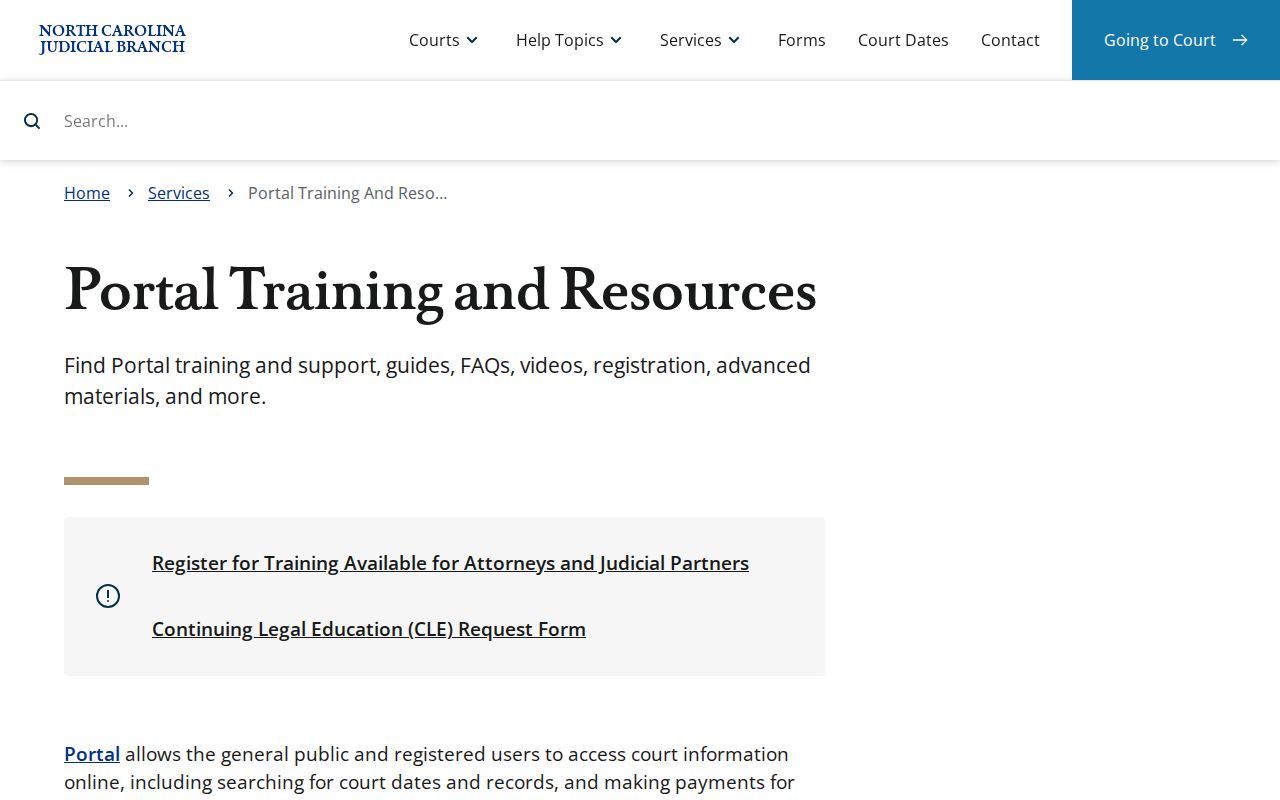
That training material is worth a closer look for Pasquotank County users. The Portal keeps a case search and a Search Hearings query as two separate functions, and confusing the two is a common dead end.
Court Dates and Settings in Pasquotank County
A setting is a scheduled court event, nothing more. The 2026 First Judicial District schedule lists every Pasquotank County session with a 9:00 a.m. start. That hour is an administrative opening. It is not the moment each file gets called. Its labels include Pasquotank Criminal, Admin DA, Crim/Civ, and CMCrim. The accessible text does not define every shorthand label, so never turn a schedule code into a case-specific conclusion.
Resets and continuances deserve equal care. A Pasquotank County continuance moves or vacates an earlier setting. It is not proof of dismissal. Check the newest Portal hearing entry first. Then contact the Clerk of Superior Court or the courtroom office if anything looks off. The official court-dates service adds that weather-affected cases get rescheduled, and directs people to the county clerk for local notice once normal hours resume. For a deeper walk through the search channels, the Pasquotank County court schedule page has the details.
Docket Access Under North Carolina Law
Access starts with a simple rule. North Carolina law makes clerks the keepers of court files, dockets, and indexes. So Pasquotank County records sit with the local clerk unless a statute restricts them. During regular office hours, those records are open to inspection. Electronic access may be offered on top of that. Portal carries many public Case Summary entries and documents remotely. No access path defeats a seal. A confidentiality rule or lawful limit on internet display stands just the same. When a remote result looks incomplete, the clerk counter and a public terminal still matter.
Key North Carolina access rules:
G.S. 7A-109 requires clerks to maintain court files, dockets, and indexes and generally opens them for inspection.
Chapter 132 states the public-record policy and limits the duty to provide existing records.
G.S. 7B-3000 makes juvenile court records confidential except for authorized access.
G.S. 15A-145.2 describes an expunction route for covered qualifying matters.
Sealed and confidential cases never surface through Portal. Domestic-violence and protective-order material can carry special online limits too. A missing Pasquotank County result is not automatically a restriction, though. Spelling errors, a wrong filter, conversion timing, or a record needing local inspection can all produce the same blank screen.
Pasquotank County Docket Access Limits
Ask where a case is available, not just whether it is public. Portal is free for Pasquotank County public data. It usually returns the Case Summary, public entries, and any available documents. Clerk-office public terminals offer another route. Statewide kiosk guidance says those terminals reach Portal, Guide & File, and File & Serve while printing records or scanning documents. No terminal count or room location is listed for Pasquotank County. Ask that practical question at the counter.
Image trouble has its own fixes. Portal downloads documents one at a time. A large scanned file can require clerk reprocessing. For a historical paper file, a missing public image, or a certified copy, go to the local clerk. Skip the statewide NCAOC public-record request form for those. NCAOC states plainly that it is not the custodian of individual Pasquotank County court documents. It routes case-file requests back to the county clerk.
How the Clerk Keeps Docket Records
One office in Elizabeth City holds the keys. The Pasquotank County Clerk of Superior Court keeps the court docket and files for Superior Court and District Court alike. Criminal, civil, and special-proceeding records all sit there. Estate records and other court-filed papers do too. Pasquotank County has no separate county clerk and district clerk splitting the work.
Where do you start? Portal, the state eCourts system, covers a free public search of the Pasquotank County court docket. But the clerk's counter is the place for inspecting a file, getting a copy, or receiving a certified record with a seal.
Copies cost money. G.S. 7A-308 sets the clerk's fees: $2 for the first page of a document and $0.25 for each additional page or fraction. A certificate under seal is $3, and an exemplification runs $10. A certified single-county criminal record search costs $25. The office publishes no standard request form or turnaround time, so call ahead to confirm payment and submission details.
Pasquotank County Clerk of Superior Court
Pasquotank County Courthouse
206 E. Main St.
Elizabeth City, NC 27909
Mail: PO Box 449, Elizabeth City, NC 27907
(252) 331-4624 direct clerk line
Monday through Friday, 8:30 a.m. to 5:00 p.m.
Pasquotank County Paper Docket Files
Paper still matters in Pasquotank County. The courthouse at 206 E. Main dates to 1882. An earlier one burned in 1862. A 1938 WPA annex and later office wings were added over time. That long history explains why the clerk's custody over older files runs so deep. It does not mean any particular modern record is missing. For older court records, the courthouse remains central.
eCourts changed the format, not the custody. Case events moved to Portal. Yet paper documents already in the clerk's hands stayed at the office. Bring the full case number when you can. Say what you want done with the file. Do you want to inspect it, get an ordinary copy, or have it certified? That distinction keeps a Case Summary request apart from a request for the whole docket file behind it.
The Judicial Branch data and statistics resource shows how Pasquotank's court records fit within the wider North Carolina court system.
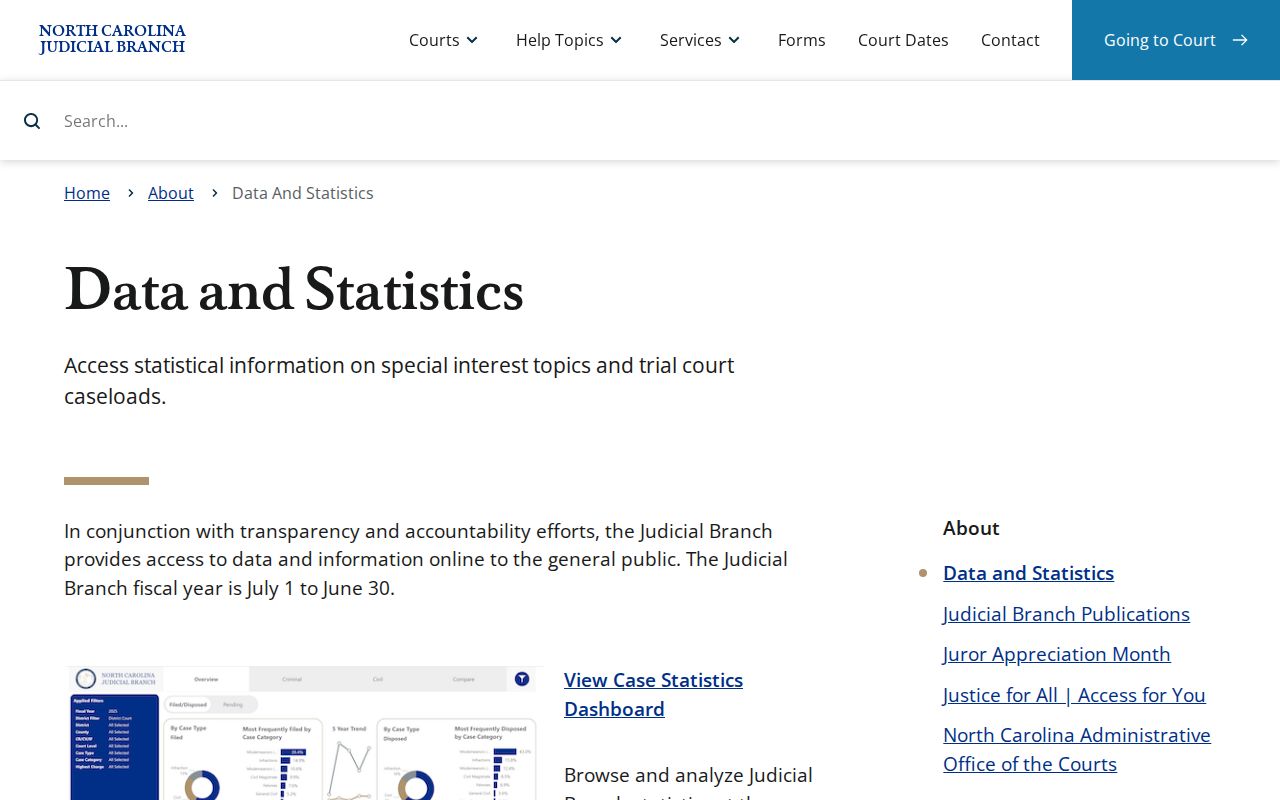
The state dashboard can be filtered by county and case type. Still, it is a reporting tool. It is not a stand-in for a Pasquotank case record.
County statistics give useful court-system context. But a case number and the clerk's record remain the route to a specific docket.
Pasquotank County Docket and Federal Cases
State and federal dockets live in separate worlds. Pasquotank County sits in the Northern Division of the U.S. District Court for the Eastern District of North Carolina, and none of those federal cases appear in the Pasquotank Clerk Portal. For federal docket research, start with the PACER Case Locator and the court's CM/ECF system. PACER works on a paid account model. Portal gives free basic public access to state courts.
The Elizabeth City federal location is an unstaffed clerk's office. Do not treat it as a substitute for the Pasquotank clerk counter. A federal docket runs on numbered docket entries with document links. The Portal Case Summary instead uses the state's Case Events and Register of Actions model. Questions about certification or completeness go to whichever court owns the record.
PACER's official pricing information shows how the federal access path differs.
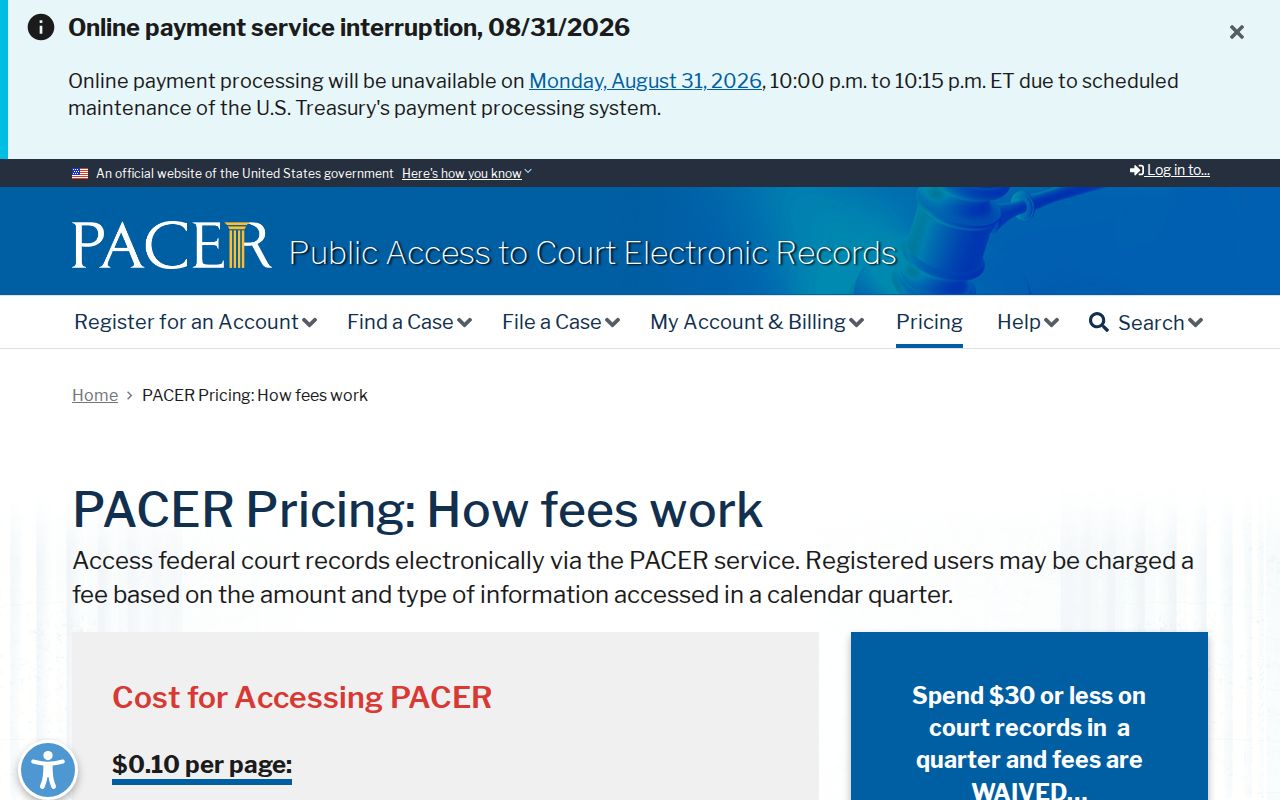
The federal pricing page confirms the point: PACER and the free North Carolina Portal serve two different court systems.
City-by-City Court Dockets in Pasquotank County
Elizabeth City stands alone as Pasquotank County's only incorporated municipality in the cited population material. Its City Clerk office points people toward the Pasquotank County Clerk of Court. That covers court dates and appearances. Traffic tickets go there too. No Elizabeth City Municipal Court exists. The city posts no municipal court calendar, judge, or docket of its own. State court cases arising in the city follow the county clerk and Portal routes described above.
City parking notices run through a separate municipal process. Handle those with the notice itself and the responsible city office. A state citation or court case is never automatically a City Hall record. The city-specific page keeps that custody line clear. It offers the same Portal, hearing-search, clerk-copy, and traffic routes used for any Pasquotank County court docket.
Elizabeth City Court Records
19,807 estimated population, July 1, 2024
State court dates, traffic cases, and court files route to the Pasquotank Clerk, not a separate city court.
Map and Directions to the Pasquotank County Courthouse
Superior Court and District Court records for Pasquotank County are kept at the Pasquotank County Courthouse, 206 E. Main Street, in downtown Elizabeth City. The Clerk of Superior Court runs a single unified office there for civil, criminal, estate, and financial matters rather than separate counters for each division. The building is the 1882 historic courthouse, since expanded with a 1938 WPA rear annex and 1979-80 office wings, and it remains the place to view paper files that predate the county's 2024 eCourts conversion.
Pasquotank County Courthouse
206 E. Main St.
Elizabeth City, NC 27909
(252) 331-4600
Monday through Friday, 8:30 a.m. to 5:00 p.m.
No official Pasquotank source publishes a parking policy, security-screening procedure, or entrance-specific accessibility route for the courthouse, so a call to the clerk's office before visiting is the best way to confirm current entry rules and which counter handles a given matter.